

Good footwork separates fighters who survive from fighters who dominate. You can throw the hardest punches in the gym, but without proper movement, you will never land them cleanly or avoid what is coming back at you. Boxing footwork drills for beginners build the foundation that every other skill depends on — balance, distance management, and ring control. Muhammad Ali floated across the canvas because he drilled basic movement patterns thousands of times before he ever made them look effortless. This guide breaks down eight drills, ordered from simplest to most complex, so you can build that same foundation from your first day in the gym.
– 8 footwork drills arranged in progressive difficulty
– Proper boxing stance and weight distribution before you start moving
– A drill progression chart from beginner through advanced
– Common mistakes that cause ankle injuries and how to avoid them
– How legends like Ali, Lomachenko, and Sugar Ray Robinson trained their feet
1. The Boxing Stance: Get This Right Before You Move
Related Reading
Every beginner boxing footwork drill starts from one position — the proper boxing stance. If your stance is wrong, no amount of drill repetition will fix the problems that follow. Your feet should be roughly shoulder-width apart, with your lead foot pointing slightly inward (about 15 degrees toward your center line) and your rear foot angled at about 45 degrees. Your weight sits roughly 60/40 on the front and back foot respectively, and your knees stay slightly bent.
Think of your stance as a coiled spring. You need enough tension in your legs to move explosively in any direction, but not so much that you are rigid and slow. Keep your heels slightly elevated — you move on the balls of your feet, never flat-footed. Sugar Ray Robinson, widely considered the greatest pound-for-pound fighter who ever lived, maintained such a precise stance that trainers still study his old footage to teach proper foot positioning in boxing.
A common beginner mistake is standing too narrow or too wide. Too narrow and you lose lateral stability. Too wide and you sacrifice speed. Test your stance by having a training partner push your shoulders lightly from the front, side, and rear. If you stumble, adjust your width until you feel balanced in every direction.
“Footwork wins fights. If you can move, you can hit. If you can hit, you do not need to get hit.” — A coaching axiom passed down through generations of boxing trainers.
2. The Step-Drag: Your First Real Movement Drill
The step-drag is the single most important boxing movement drill a beginner will learn. Every coach in every gym teaches it because it keeps both feet underneath you at all times, maintaining your stance while you cover ground.
Here is how it works: to move forward, step with your lead foot first (just a few inches), then drag your rear foot to reset your original stance width. To move backward, the rear foot steps first and the lead foot follows. Moving left, the left foot leads. Moving right, the right foot leads. The rule is simple — the foot closest to the direction you want to go always steps first.
Key technical points to remember:
– Keep each step small, roughly six to eight inches at most
– Your feet should never cross or come together — maintain stance width after every step
– Stay on the balls of your feet throughout the movement
– Push off with the toes of the trailing foot rather than lifting and placing it
– Keep your guard up while moving; hands drop when beginners focus on their feet
Practice the step-drag in all four directions for three-minute rounds with one-minute rest periods. Once you are comfortable with straight-line movement, combine directions: step forward twice, then laterally once. This teaches you to change angles, which is what footwork is really about in a fight.
If you are working on your stance and basic movement at home, our guide on how to start boxing at home covers the space and equipment you need to train effectively.
3. Lateral Shuffle Drill
The lateral shuffle builds on the step-drag by increasing your speed of lateral movement. Where the step-drag is deliberate and controlled, the shuffle teaches you to cover ground quickly while staying balanced — essential for cutting off the ring or escaping the ropes.
Begin in your boxing stance and move laterally using the step-drag pattern, but increase your tempo. You are not bouncing or hopping. Your feet stay close to the floor, almost gliding. Imagine there is a sheet of paper between your feet and the ground — you should not have enough clearance to slide a book under your soles. This keeps you grounded and ready to punch or defend at any moment.
– Shuffle laterally for 10 feet, stop sharply, then shuffle back
– Perform 5 round trips per set, 3 sets per training session
– Keep your hands at chin height the entire time
– Focus on staying low rather than standing tall and drifting
To add resistance, try this drill on a slightly cushioned surface or wear quality boxing shoes that grip the floor without catching. Cheap sneakers with thick rubber soles will stick to gym floors and mess up your sliding motion.
4. The Pivot: Creating Angles Like a Pro
The pivot is where footwork transitions from simple movement to tactical ring craft. Pivoting lets you change your angle relative to an opponent without stepping backward — you rotate around your lead foot while your rear foot swings in an arc. Vasiliy Lomachenko, arguably the best footwork artist in modern boxing, uses pivots so frequently that opponents often punch empty space where he stood a split second earlier.
To perform a basic pivot, plant the ball of your lead foot and rotate your body 45 to 90 degrees by swinging your rear foot around. Your lead foot acts as the axis. After the pivot, you should be facing a new angle while your opponent is still squared up to where you used to be.
– Start with small 45-degree pivots before attempting 90-degree or full 180-degree turns
– Always pivot off the ball of the foot, never the heel
– Your upper body and hips rotate together with your feet — do not twist at the waist
– Practice pivoting after throwing a jab to simulate real fight movement
Learning to pivot effectively also strengthens your defensive repertoire. It pairs naturally with slipping, which you can explore in our breakdown of how to slip punches in boxing.
Improper pivoting is one of the most common causes of ankle injuries in boxing. If you pivot on a flat foot or twist your ankle rather than rotating on the ball of your foot, you risk sprains and chronic instability. Beginners should drill pivots slowly on a smooth, dry surface before adding speed. If you feel any pinching or pain on the outside of your ankle during pivots, stop immediately and check your foot placement. Wearing boxing shoes with proper ankle support significantly reduces this risk compared to training barefoot or in running shoes.
5. Jump Rope for Rhythm and Coordination
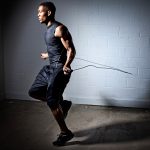
Jump rope is not just a warm-up. It is a serious footwork development tool that builds the rhythm, timing, and calf endurance that every other drill on this list depends on. There is a reason every professional boxer from the 1920s to today skips rope as part of their daily training.
Start with basic two-foot bouncing for two-minute rounds. Keep your jumps small — no more than an inch off the ground. Your wrists do the work, not your arms. Once the basic bounce feels natural, introduce the boxer skip: a slight alternating weight shift from one foot to the other, almost like a light jog in place. This mimics the weight transfer you use when moving in your stance.
– Begin with 3 rounds of 2 minutes, resting 30 seconds between rounds
– Progress to 5 rounds of 3 minutes as your conditioning improves
– Add single-leg hops and double-unders once the basic skip is automatic
– Focus on breathing steadily; if you are gasping, slow the rope speed down
An agility ladder makes an excellent companion tool for jump rope training. Both develop fast-twitch muscle fibers in your calves and teach your brain to coordinate rapid foot placement patterns.
Before starting any intense footwork session, make sure you warm up properly. Our boxing warm-up routine covers dynamic stretching and mobility work that protects your ankles and knees during drills.
6. Shadow Boxing With Footwork Focus
Shadow boxing is where you take every drill you have practiced in isolation and combine them into flowing, realistic movement. Most beginners shadow box by standing still and throwing punches at the air. That misses the point entirely. Shadow boxing should be a foot positioning boxing drill first and a punching drill second.
Set a timer for three three-minute rounds. During each round, focus on a different movement pattern. Round one: step-drag in all four directions while throwing your jab. Round two: lateral shuffles with jab-cross combinations. Round three: pivots after every combination of three or more punches.
The goal is to never stand still. After every combination, move. After every defensive action, move. After every pivot, reset your stance and move again. Watch footage of Sugar Ray Robinson shadow boxing — his feet never stopped, and every punch flowed out of his movement rather than interrupting it.
– Use floor tape to mark a 10×10 foot square and stay inside it, simulating ring boundaries
– Film yourself from the front and side to check if your feet stay in proper stance throughout
– Throw at least one punch after every directional change to build the habit of moving with purpose
Lomachenko’s father had him train with Ukrainian traditional dance (Hopak) as a child to develop extraordinary foot coordination and spatial awareness. You do not need to take dance classes, but putting on music during your shadow boxing rounds and moving to the beat teaches your body to find rhythm naturally. Rhythm in footwork means you can change tempo to confuse opponents — moving slowly to lull them, then exploding with a fast lateral shift when they commit to a punch.
7. Cone Weave and L-Step Drill
Once you have built a base with the previous drills, the cone weave introduces multi-directional agility under more structured conditions. Set up four to six cones (or water bottles) in a straight line about three feet apart. Weave through them using step-drag footwork, keeping your stance intact as you navigate each cone.
The L-step builds on this by adding right-angle direction changes. Mark out an L-shape on the floor with tape. Move forward along the first line using step-drags, then pivot 90 degrees at the corner and continue laterally. This drill mirrors a real fight scenario — moving forward to cut off an opponent, then pivoting to stay in front of them when they try to circle away.
– Perform 5 full runs through the cones, rest 30 seconds, repeat 3 times
– Keep your guard up throughout — if your hands drop, start the run over
– Increase speed gradually across sessions; technique matters more than pace
– Time yourself to track improvement week over week
These drills develop the ability to maintain proper boxing stance while changing directions rapidly, which is the entire purpose of beginner boxing footwork training.
8. Partner Mirror Drill
The partner mirror drill bridges the gap between solo footwork training and actual sparring movement. One partner leads, the other follows, mirroring every step, shuffle, and pivot in real time. The leader should vary tempo and direction randomly to keep the follower reacting rather than anticipating.
This drill builds several skills simultaneously. The leader practices offensive footwork — cutting off angles, pressing forward, and controlling ring space. The follower practices defensive footwork — maintaining distance, circling away from pressure, and pivoting out of corners. Both fighters develop their ability to read movement and react without thinking, which is what footwork looks like when it becomes instinctive.
– Start with 2-minute rounds, alternating roles each round
– The leader should use only step-drags and shuffles for the first few sessions before adding pivots
– Maintain a consistent distance of about four feet between partners
– Add jabs to the drill once both partners are moving fluidly without breaking stance
Drill Progression Chart
Use this table to structure your footwork development over your first 12 weeks of training.
| Drill | Beginner (Weeks 1–4) | Intermediate (Weeks 5–8) | Advanced (Weeks 9–12) |
|---|---|---|---|
| Step-Drag | 4 directions, slow tempo, 3 rounds | Combined directions, moderate tempo, 5 rounds | With punch combos, fast tempo, 5 rounds |
| Lateral Shuffle | 10-ft back and forth, 3 sets | 20-ft with stops on command, 4 sets | With defensive slips at each stop, 5 sets |
| Pivot | 45° pivots, stationary, 2 rounds | 90° pivots after jab, 3 rounds | 180° pivots after combos, live partner, 4 rounds |
| Jump Rope | Basic bounce, 3 × 2 min | Boxer skip + single-leg, 4 × 3 min | Double-unders + direction changes, 5 × 3 min |
| Shadow Boxing | One movement per round, 3 rounds | Mixed movement, 4 rounds | Full offense/defense flow, 5 rounds |
| Cone Weave / L-Step | Walk-through speed, 3 runs | Moderate speed, timed, 5 runs | Full speed with punches, 8 runs |
| Mirror Drill | Step-drag only, 2-min rounds | Add shuffles + pivots, 3-min rounds | Add jabs + feints, 3-min rounds |
| Agility Ladder | In-in-out-out pattern, 3 sets | Icky shuffle + lateral entries, 5 sets | Ali shuffle pattern, timed, 6 sets |
Common Beginner Footwork Mistakes to Avoid
Even dedicated beginners fall into habits that undermine their footwork development. Knowing these pitfalls early saves months of corrective work later.
The most frequent error is crossing your feet. When your feet cross during lateral movement, you lose balance and become an easy target. Your feet should always maintain stance width, no matter which direction you move. The step-drag pattern exists specifically to prevent this — trust the system and resist the urge to take large, crossing steps.
– Standing too upright removes the spring from your legs and slows every movement
– Watching your feet instead of keeping your eyes up trains a terrible habit for sparring
– Bouncing too high off the ground wastes energy and leaves you airborne when you need to react
– Neglecting rear foot positioning after each step slowly widens or narrows your stance without you noticing
– Moving without purpose — every step should have a tactical reason, even in drills
Muhammad Ali appeared to break some of these rules. He stood taller than most fighters and sometimes crossed his feet deliberately. But Ali had drilled orthodox footwork for years before he developed his unique style. He knew the rules well enough to break them selectively. As a beginner, master the fundamentals first.
Frequently Asked Questions
1. How long does it take to develop good boxing footwork?
Most beginners start to feel comfortable with basic movement patterns after four to six weeks of consistent practice, training three to four days per week. However, truly instinctive footwork — where you move without thinking — typically takes six months to a year of regular drilling. Footwork is a perishable skill, so even experienced fighters continue to drill the basics throughout their careers.
2. Can I practice boxing footwork drills at home without equipment?
Absolutely. The step-drag, lateral shuffle, pivot, and shadow boxing drills all require nothing more than a flat surface and enough space to move about 10 feet in each direction. Painter’s tape on the floor can substitute for cones or ring boundaries. An agility ladder is affordable and useful but not essential — you can draw a ladder pattern with tape or chalk on a garage floor.
3. Should I buy boxing shoes for footwork training or can I train in regular sneakers?
Boxing shoes make a noticeable difference for footwork training. They have thin, flat soles that let you feel the ground and pivot smoothly, along with higher ankle support that protects against rolling your ankle during lateral drills. Regular sneakers have thick, cushioned soles designed for forward motion, which makes pivoting harder and can actually increase your ankle injury risk. If you are training more than twice a week, investing in proper boxing shoes is worth it.
Conclusion
Solid footwork is the quiet skill that makes everything else in boxing work. The eight drills covered here — from the fundamental step-drag to the partner mirror drill — give you a structured path from complete beginner to confident mover. Boxing footwork drills for beginners do not need to be complicated or flashy. They need to be practiced consistently with attention to stance integrity, balance, and controlled movement. Put in three rounds of focused footwork work at the start of every training session, and within a few months you will move with the kind of purpose and control that makes coaches notice and opponents hesitate.
Disclaimer: This article is for informational and educational purposes only. Consult a qualified boxing coach before beginning any new training program, especially if you have prior ankle or knee injuries.
Written by the AskMeBoxing Team



2 thoughts on “Boxing Footwork Drills for Beginners: 8 Essential Drills That Build Real Ring Movement”
Comments are closed.